When deciding for or against an infrared heater, the most important factor should not be the appearance, but first and foremost the effectiveness of the heater. But when can an electronic heating system actually be called an “infrared heating system”? What minimum requirements must be met and how do we at Könighaus fare? In this article, you will learn more about the radiation efficiency factor and why it is decisive for the quality of your infrared heater.
Radiation efficiency – what is it actually?
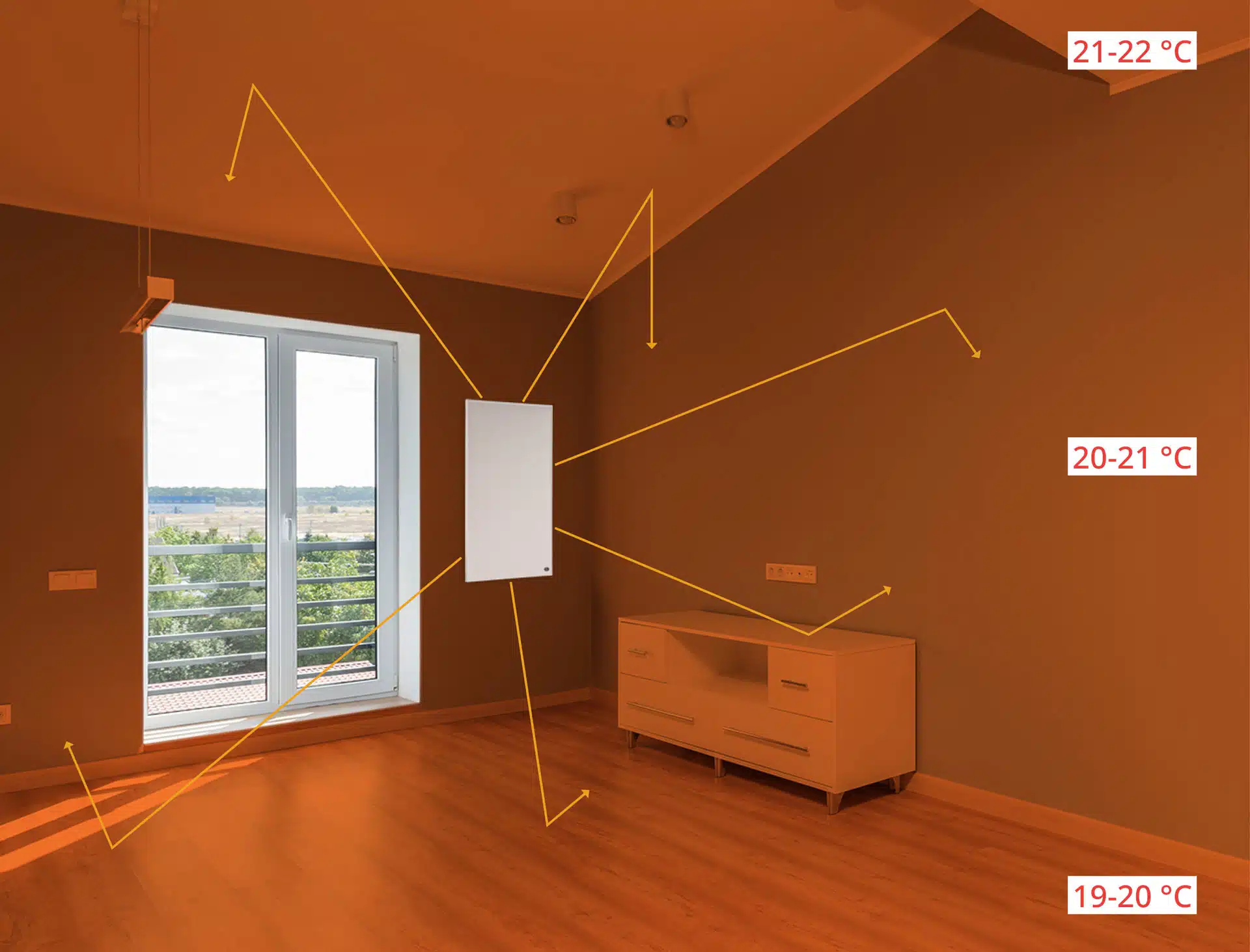
For infrared heaters, radiation efficiency refers to the efficiency with which the heater converts electrical energy into infrared radiation. As infrared heaters mainly generate heat by emitting infrared radiation, a high radiation efficiency is desirable to ensure efficient and even heat distribution.
This means that a large proportion of the electrical energy absorbed is emitted in the form of infrared radiation, while less energy is converted into other forms such as convection or heat conduction. To assess the efficiency of infrared heaters, the radiation efficiency can be used as a benchmark. A higher radiation efficiency leads to a more efficient and targeted heat transfer, as the infrared radiation hits people, objects or surfaces directly, heats them and then releases the heat into the environment.
The new DIN EN IEC 60675-3 standard
The IEC 60675-3 standard is a method for determining the radiation efficiency of electric direct heaters or low-temperature infrared heaters with surface temperatures between 40°C and 200°C. This standard has created a basis for determining whether a heater can be classified as an infrared heater or not.
The definition of the radiant efficiency factor was developed and established by the international, non-governmental standardization organization International Electrotechnical Commission (IEC) , among others. The effective heat output transferred to the surface of the room is measured on this basis. The minimum value to be achieved is 40 percent. This ensures that the electric heater is a genuine infrared heater. Above this threshold, the heat output transferred by infrared radiation outweighs that of each of the other two heat transfer types, i.e. both convection and conduction[1].
Könighaus infrared heaters – Above the norm!
We have had Könighaus infrared heaters of the P-series and M-series tested by the Technical University of Dresden for their radiation efficiency. The result: Our infrared heaters not only passed the test, but also achieved 92.8 percent of the maximum achievable value with an underlying factor of 0.7.
This means that Könighaus Infrarot ‘s infrared heaters not only have an above-average proportion of radiation, but are also optimally prepared for a climate-friendly and energy-safe future.
Conclusion
The IEC 60675-3 standard helps you to assess the efficiency and effectiveness of an infrared heater. Based on this information, you can be sure when buying an infrared heater that the heater is a genuine infrared heater. We at Könighaus not only offer you guaranteed genuine infrared heaters, but also particularly efficient heaters manufactured in Germany.
[1] GUIDE TO INFRARED HEATING
BVIR Bundesverband Infrarot-Heizung e. V. and IG INFRAROT Deutschland e. V. (ed.)
A brief introduction to the field of infrared heating
Dr. Ing.