
In the first part of our topic “Sustainability on the Internet”, we looked at the content of search queries, the resulting energy consumption and the impact of social media services. In the second part, we ask ourselves the question: what and how can we change things to conserve resources and protect the environment?
What can we change – sustainability on the Internet
First of all, it is important to become aware of this problem. This starts with making data centers more climate-friendly by sourcing electricity from renewable sources. Or locating data centers in areas where it is cold anyway and the server rooms do not need to be cooled down.[1] Furthermore, “green programming” is being used to make data volumes smaller through compression processes and thus save energy. For example, some programming languages consume considerably less power than others. In addition, servers can be set up so that they only run at maximum performance when a large number of users are actually online. [2]
One major problem is the rebound effect. This means that increasing energy efficiency in the digital sector is not leading to less electricity being consumed, but exactly the opposite. The possibilities are being pushed to the limit. [3]
It is therefore not enough to simply appeal to the responsibility of each individual. Possible approaches would be, for example, to replace flat rates with price offers with limited data volumes or to persuade the platform operators of streaming services to change their mechanisms for keeping users on the platform for as long as possible. [4]
Saving energy – but how?
We have put together some ideas and tips here on how you can take small steps to reduce your electricity consumption on the internet and make your everyday life more climate-friendly.
- Your devices continue to consume power in standby mode – disconnect them from the power supply if possible.
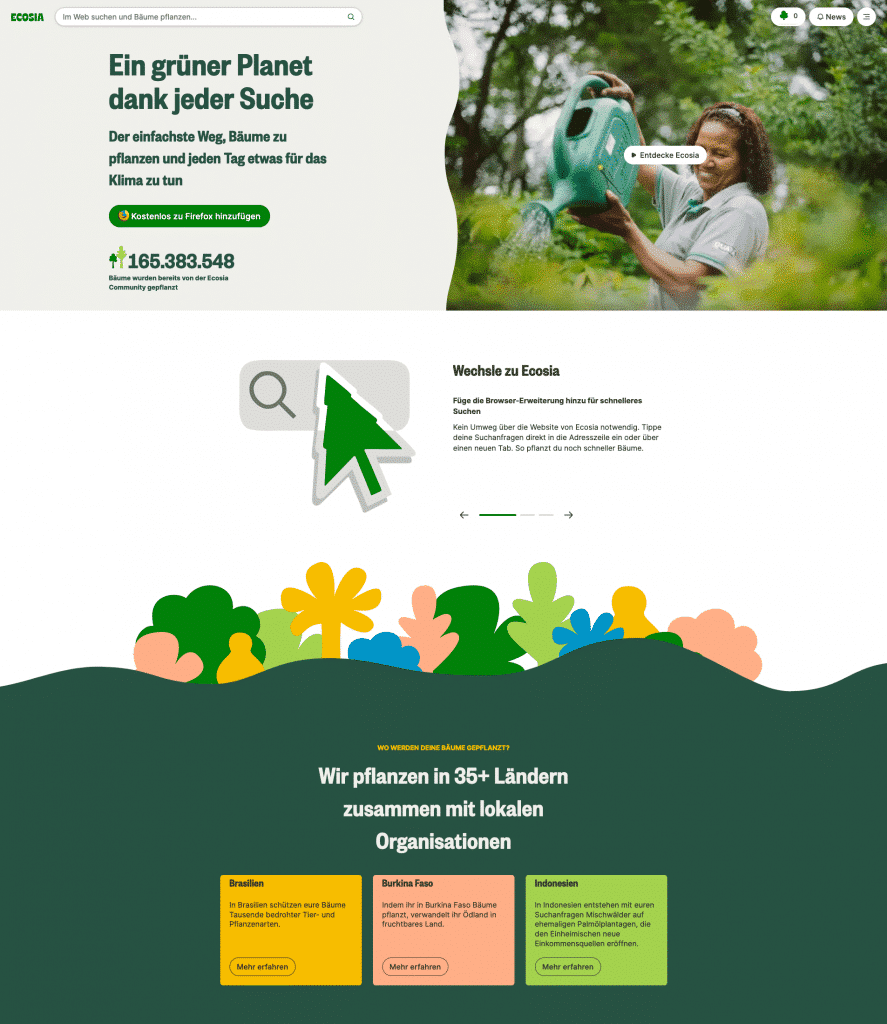
- Use sustainable search engines such as Ecosia, Gexsi, Ekoru or Lilo. Some of these are powered by 100% renewable energy or use 100% of their profits for social purposes. You can find more detailed information on the four search engines summarized in a table here.
- Reduce the quality of your videos – less energy is required for playback and it doesn’t always have to be 8K quality, does it?
- Regularly delete your old emails from your inbox
- Set up a spam filter and update it regularly
- Use smaller (TV) screens
- Download songs that you listen to regularly. That way you don’t have to stream them every time, which saves energy.
- Do you listen to music on YouTube but don’t actually watch it? Then save the video and your data transfer won’t skyrocket.
- Switch to green electricity.
- Reduce your screen resolution
- Switch off the autoplay function on YouTube, Netflix, etc. This prevents the next video from starting immediately.
- Be aware of whether you have to share every funny cat video reflexively.
- Clean up your cloud regularly and clear out from time to time. Or use external hard disks
- Do you really check all your notification emails, or can you deactivate some of them?
- Even though it’s nice to say “thank you”, you don’t have to say thank you for every email. A British study has found that Britons send up to 64 million emails a day – consisting of 1-2 words with the content “thank you”, “have a nice weekend” and “received”. This causes CO2 emissions of 23475 tons per year and is equivalent to 80000 flights from London to Madrid. (‘Think Before You Thank’ | OVO Energy, 2019)[5]
- Don’t use a screen saver, it only uses unnecessary energy. Leave the screen dark instead. ATTENTION: a screen saver does not mean that your computer is in sleep mode and saving energy.
- Use WLAN or LAN if possible. This is because a mobile connection consumes more energy than a stationary connection. The most environmentally friendly way to stream is via a fiber optic connection.
Conclusion
We all need to realize that no click on the internet is free. Just because the digital world is available around the clock does not mean that we can use it carelessly. Because in the end it falls back on us. We consume vast amounts of energy, which in turn has to come from somewhere. This is at the expense of the environment, which we are feeling through the change in climate conditions. It is therefore up to each and every one of us to critically question our own digital consumption and pay more attention to the topic of “sustainability on the internet”.
The otters will thank you!
? ??
Want to know more?
There is a lot more exciting information to discover on our blog. Take a look at our latest article on the possibilities of a smart home. Or have you already read the article about our company? Here you can find out what makes Könighaus so special. If you have any further questions, our friendly customer service team will be happy to help you – by phone, email or chat. We look forward to hearing from you.