Heat pumps and infrared heaters are considered to be forward-looking heating systems. Both systems work without fossil fuels. What’s more, both technologies run on green electricity. Two different systems, but bothCO2 neutral. Let’s take a look at how a heat pump works and its advantages. How does it differ from infrared heating? At the end of the article, we show you how you can easily calculate after how many years a heat pump would have economic advantages.
How does a heat pump work?
Heat pumps make use of natural resources. They draw thermal energy either from the air, groundwater or the ground. A refrigerant is required to generate heat. The pump extracts heat from nature in order to convert the liquid refrigerant into vapor. You can imagine the whole process as being similar to cooking spaghetti. Before cooking the spaghetti, we grab a pot and bring the water to the boil. The boiling water starts to steam. Unlike the spaghetti water, the refrigerant evaporates at very low temperatures.

A compressor is now required to compress the refrigerant vapor. The compression of the steam increases its temperature. The heated steam can now be used for heating or hot water. Once it has cooled down again, it turns back into liquid refrigerant. And so the cycle can start all over again.
An ingenious system, isn’t it? Incidentally, electrical energy, i.e. electricity, is required to compress the steam.
A brief digression into physics: energy is expended during the conversion from “liquid” to “gaseous”. Conversely, energy is released when “gaseous” becomes “liquid”. And it is precisely this effect that the closed system of the heat pump makes use of.
Heat recovery options
Air: The heat pump is equipped with fans. The fans are used to draw in ambient air.
Earth: Surface collectors or geothermal probes are used to harness the heat stored in the earth.
Groundwater: Underground groundwater is used to generate heat. The temperature of the groundwater remains largely constant throughout the year. The advantage for the heat pump is that it can achieve a high level of efficiency all year round.
Advantages of a heat pump
The advantages of a heat pump are obvious. The heat pump draws part of its thermal energy from the environment. Firstly, this is sustainable and secondly, it doesn’t cost you any money. The pump draws approx. 75 % of the total energy from nature. For the remaining 25 %, the heat pump requires electricity at a charge.
As the heat pump not only uses electricity, but also makes use of the properties of nature, it is particularly efficient. This means that 1 kWh of electricity generates approx. 3-5 kWh of heat. Of course, the value can vary depending on the type of heat pump (air, earth, groundwater). If you also use green electricity, i.e. electricity generated by the sun, wind or hydropower, you can heat in a completelyCO2-neutral way.
Heat pump costs
As the groundwater heat pump achieves the highest efficiency, let’s take a closer look at the associated costs.
A water-to-water heat pump requires two wells that reach down to the groundwater. Water is drawn in through one well (suction well) and the cold water used is pumped back into the groundwater through the other well (absorption well). As a rule, the groundwater must be pumped back into the ground to the same depth as it was extracted.
A groundwater analysis should be carried out before installing the wells. This is because damage to the heat pump can occur if the groundwater quality is not appropriate. This leads to higher maintenance costs. Although heat pumps are generally low-maintenance, they should be professionally inspected at regular intervals to ensure their longevity.
One disadvantage of the water-to-water heat pump is the high cost of acquisition and development. The costs for well construction and for purchasing and installing the heat pump are in the lower five-figure range. Annual maintenance costs must also be factored in.
Interim conclusion heat pump
A heat pump is a sophisticated system that harnesses the heat of nature and achieves a particularly high level of efficiency. However, the purchase costs are high and annual costs for maintenance and any repair work should also be factored in.
Comparison: Infrared heating
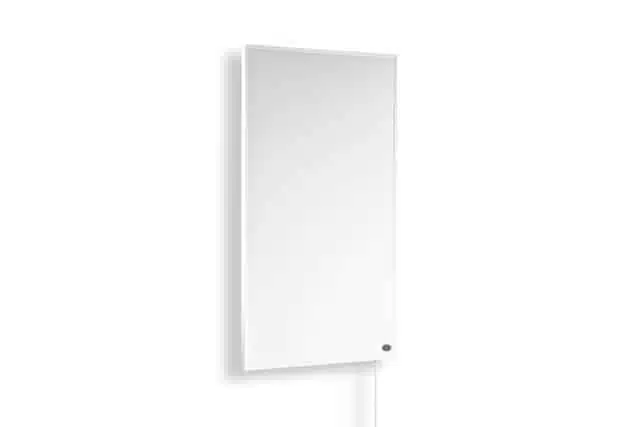
While the planning of the water-to-water heat pump involves a great deal of red tape and the installation is also complex, infrared heaters work according to the plug and play principle. The simplest form of installation is wall mounting. The infrared heater is attached to the wall using a drilling template and mounting accessories. The whole process is similar to hanging a picture. Then plug it into the socket – and off you go. Pretty much anyone can do this themselves at home and there is no need to call in an installer.
Compared to heat pumps, infrared heaters are exceptionally inexpensive to purchase. An infrared heater can be purchased for less than 200 euros. In addition, no maintenance work is required. Compared to similar electric heaters, e.g. fan heaters, infrared heaters are very efficient because they convert one unit of electricity almost completely into one unit of heat.
Now let’s imagine the heat pump and infrared heating side by side. The heat pump involves high initial costs. Running it on electricity is particularly cost-effective, as a water-to-water heat pump can generate up to five units of heat from one unit of electricity. Infrared heating is particularly inexpensive to purchase and there are no maintenance costs. In terms of maintenance, infrared heating requires comparatively more electricity to produce the same amount of heat.
This raises the question of the interface. How many years does it take for the heat pump to pay for itself compared to infrared heating? From what year does the heat pump have a cost advantage advantage over infrared heating? And what is the life expectancy of the heat pump once the interface has been reached?
You can use this calculation to determine after how many years a heat pump will pay for itself compared to an infrared heater. The unknown “J” stands for years. If you enter fictitious costs and solve for J, you get the interface.
(Acquisition costs heat pump) + (Maintenance costs x Y) + (Operating costs x Y)
= (Acquisition costs infrared heating) + (Operating costs x Y)
Economic calculation
A number of individual factors are included in the calculation. The following points can help to determine which heating method makes the most economic sense:
- Acquisition costs
- Amortization of the purchase
- Costs for maintenance and repair work
- Life expectancy of the heating system
- Power consumption
Conclusion
The water-to-water heat pump in particular is undisputedly a very efficient heating method. One of its downsides is the enormously high purchase costs and bureaucracy involved. Determining whether alternative heating with infrared makes economic sense for your own household? The questions in the “Economic calculation” section can help with this. What is certain, however, is that infrared heaters are particularly inexpensive to purchase and do not require any maintenance work.
Would you like to find out more about infrared heating or receive detailed advice? Then contact our friendly customer service team. They will be happy to help you with advice.