Everyone needs it, everyone has it – 96.2% of German households own a washing machine. But that’s not all: 2.65 million electric stoves were sold in 2021, 3.85 million refrigerators and, not to forget, around 42.7% of Germans owned a tumble dryer in 2021.1 Reason enough to ask yourself: what should you look out for when buying a washing machine & co? How can you save energy and which appliances make sense?
Your electrical appliance is broken? What now?
Are you moving house and need a new stove? Or your washing machine broke down yesterday and you’re wondering: what should I look out for when buying a new machine?
As with all everyday objects, electrical appliances are also subject to wear and tear. Be it the seals that become porous or electrical components that break. Small things can be repaired inexpensively, but if, for example, the compressor of your refrigerator is broken, the question arises: repair it or buy a new one? Depending on the age of the appliance, buying a new one makes sense for economic reasons alone, as technical progress has made it more energy-efficient and the appliance consumes significantly less electricity. If your old appliances are still working but you want to buy a newer model, you don’t have to dispose of them immediately: perhaps someone in your household needs a new washing machine? Or ask an aid organization – there are many people who cannot afford a new dishwasher or electric stove.
How long do household appliances last?
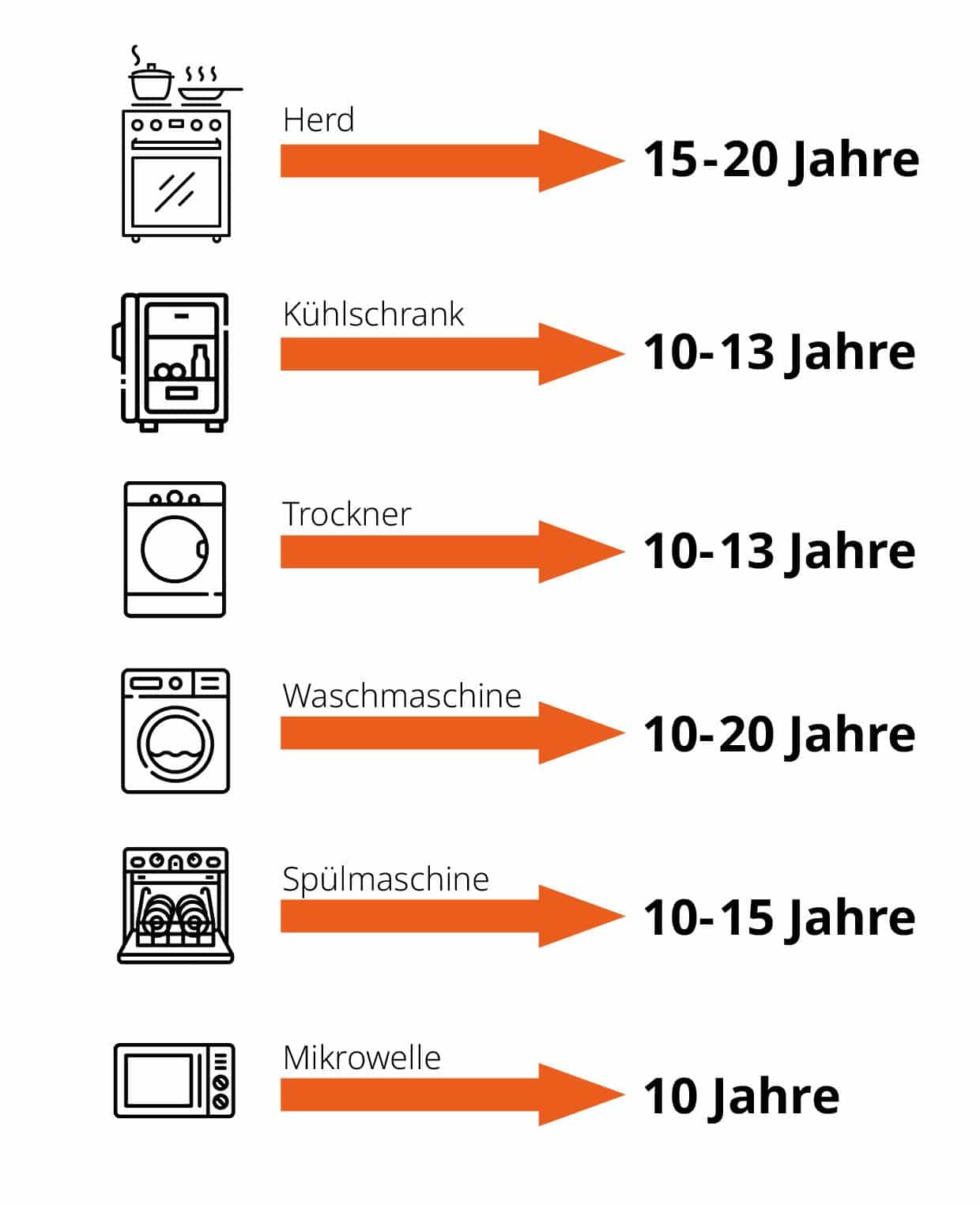
Is your device broken? So before you start looking for a new appliance, you first need to decide what to do with the old one. After all, an old appliance still contains many valuable raw materials that can be recycled. In this case, these include metals such as gold, copper and aluminum. But rare earths can also be found. All of these can be easily recycled. Possible dangers should also not be underestimated if they are not disposed of properly. Substances such as heavy metals and CFCs (chlorofluorocarbons) can cause damage to people and the environment. Therefore, make sure that you dispose of your electrical appliances correctly.
Old against new
If you want to buy a new electrical appliance from a retailer, they are obliged to take your old appliance with them and dispose of it properly.
Recycling or recycling center
You take your old appliance to a local recycling or reusable materials center yourself. This is usually free of charge.
Bulky waste
In some municipalities, there are fixed days on which bulky waste is collected. In others, you have to arrange a collection date yourself. Please note: you must register what is to be collected.
No matter which of the three options you choose, one thing is clear: refrigerators, washing machines etc. should never be disposed of illegally on the streets or in the countryside!
Washing, baking, drying – what would you like?
You’ve made up your mind: you need a new electrical appliance. Let’s take a look at the best tips and tricks to help you find your way through the jungle of washing machines and the like. Let’s get started.
To save energy, it makes sense to check the energy label before buying an electrical appliance. These labels should help you make a decision so that you can choose the most efficient household appliance possible.
Washing machine
The current efficiency classes for washing machines are A (very good) to F (very poor). The further forward in the alphabet, the more economical the appliance. This information is important so that you can estimate how high your electricity consumption can become. For example, the consumption of energy-saving washing machines is less than 50 kwh for 100 wash loads. 2

Another important point is choosing the right size of washing machine. Note: the machine is only economical when it is fully loaded. The larger the drum, the higher the water and electricity costs. Are you alone in the household or are you a family of five? Do you have four dogs or just one budgie? Before you buy, think about what makes sense for you and how likely you are to use your new washing machine to its full capacity.
In addition to individual requirements such as maximum volume or ease of use, make sure that heating the water requires the most energy. A pre-wash cycle is only necessary for extremely soiled laundry – all other laundry gets clean at 30 to 40 degrees.
Tumble dryer
Tumble dryers consume energy. A lot of energy. Condenser dryers without heat pump technology or exhaust air dryers, for example, consume much more electricity than modern heat pump dryers. Not to mention the environmental and recycling problems that a worn-out dryer entails. In addition to saving energy, you are also doing good for the environment in other ways: dryers release 40 times as many microscopic particles from clothes as washing machines3. They therefore enter the environment unfiltered. If they are microfibers or polyester, they cannot be broken down by nature. So why not do without a dryer altogether?
If this is not possible, spin the laundry as dry as possible in the washing machine before putting it in the dryer. Incidentally, moisture-controlled tumble dryers work particularly efficiently as they switch off automatically as soon as the set moisture level of the laundry is reached.
Note: As with a washing machine, you should use the full capacity of the dryer. So think about how many liters your dryer needs to hold before you buy it. This will save you energy.
Electric stove
Pasta, rice, pizza, casseroles, cakes … not much happens in our kitchens without a stove and oven. But how much energy is actually used for this? On average, a two-person household spends 10 percent of its total energy consumption on cooking and baking. So what can you do to save energy here too?
If you want to buy a new electric stove, you should consider whether induction or halogen hobs are the right choice for you. Induction hobs save up to 40 percent electricity compared to cast iron hobs. You should also make sure that the oven has a triple-glazed oven door. This is because good insulation prevents energy from being lost.
More tips and tricks:
- use the oven sparingly. You can also put bread rolls on the toaster ? ?.
- Use hot air or convection. Here you can select lower cooking temperatures and bake on several levels.
- Preheating is generally unnecessary. This saves you 20 percent energy.
- Turn the oven off earlier and use the residual heat.
- The oven door remains closed. That’s what the glass panel is for ?
Refrigerator
Did you know that there are 125 fridges for every 100 households in Germany? This means that one or two predecessor models are sitting around in German cellars. Do you have one?
Let’s take a closer look at the options for saving energy.
- Leave the food to cool. If you put them warm in the fridge, the appliance has to use a lot of energy to cool everything down.
- Going on a longer vacation? Have fun! Maybe you can empty the fridge and switch it off during this time.
- Do not place the refrigerator next to the stove or dishwasher. These appliances generate heat that the refrigerator has to compensate for.
- Your refrigerator likes shade, so avoid a sunny location.
- Make sure that your appliance is not too close to the wall. The warm air from the heat exchanger must be able to escape unhindered.
- Defrost the freezer compartment regularly.
- Do you have a balcony or terrace? Then use this “large cooling chamber” in winter. It’s available for free. And outside. Here you’ll find valuable tips on storing food outdoors.
Perhaps your fridge is more than 10 years old? Then consider whether a more energy-efficient model would be more effective and economical for you in view of rising electricity prices. You can find a calculator here to check whether it makes sense to switch.
Conclusion
Electrical appliances make life easier and more convenient – whether everything is absolutely necessary is something everyone has to check for themselves from time to time. After all, electrical appliances cost money and have a negative impact on the environment. So you can’t say across the board that it’s the best decision to keep old appliances until they break down. Sometimes switching to a more economical model is the better choice. Even if the production and the associated environmental impact should not be ignored.
Want to know more?
There is a lot more exciting information to discover on our blog. Take a look at our latest article on the possibilities of a smart home. Or are you interested in the articles about ceiling heating? If you have any further questions, our friendly customer service team will be happy to help you – by phone, email or chat. We look forward to hearing from you.