In this article you will find out what infrared is. How was it discovered and which invention is based on it? Spoiler: It also has to do with heating. We’ll tell you how to get close to infrared – with a little experiment.
The short version
Infrared is a component of sunlight. When sunlight is refracted, you see the colors of the rainbow. However, the light also contains an invisible part called “infrared”. This is the warmest component of sunlight. This makes the sun a huge, natural infrared heater.
The detailed version and an experiment to copy
What color is sunlight actually? Many people probably assume that sunlight is colorless, white or yellow. However, sunlight actually consists of different colors. When the sun shines into the rain or into a waterfall, the light is broken up into its colors and we see a rainbow. The skin colors of the rainbow are: Red, orange, yellow, green, blue and violet. Well, at least the colors that we humans can see with our naked eyes.

Is there such a thing as invisible light?
In short, yes! The colors visible to humans actually only make up the smallest part of sunlight. Just imagine the rainbow. It glows violet, blue, green, yellow, orange and red. You could ask yourself whether there is more to the left of violet and to the right of red. Or to put it another way: is there also light in the areas where we can ‘t see anything?
UV and infrared light
And that’s exactly how it is. The light next to violet is known as UV light. Where UV is the abbreviation for ultraviolet. Incidentally, “ultra” comes from Latin and means “beyond” – beyond violet. Now that we have clarified this with UV light, we can almost assume that there is more after red. Namely with infrared. And the term “infra” also has its origins in Latin and means something like “below”. So infrared means below red.
Experiment
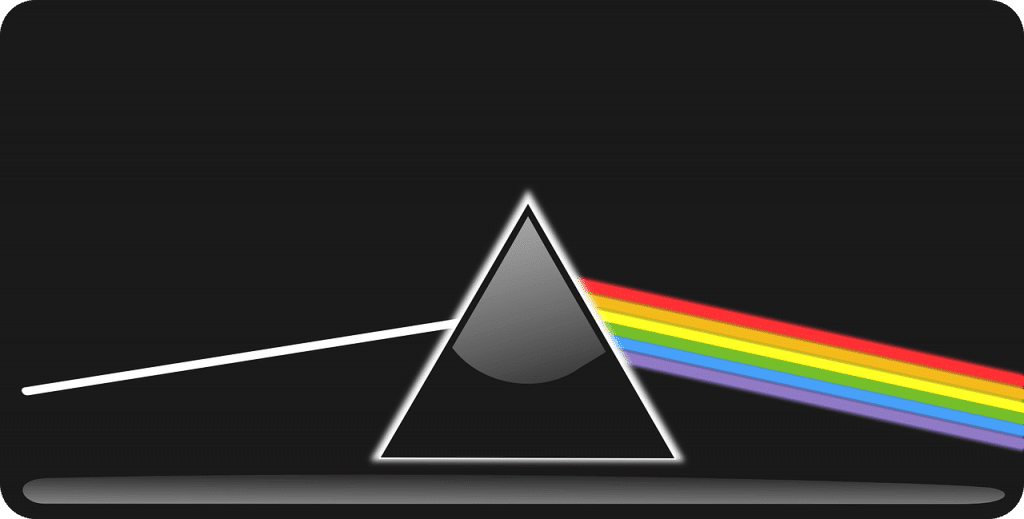
So much for the theory. Do we now have to wait until the next rainbow or is there a way to share the sunlight ourselves? And yes, there is. You need a glass prism and the sun. It also works with artificial light, but then the effect is not as great.
The sunlight must be focused onto the glass prism. You can use a slit-shaped aperture for this, for example. The light beam is refracted by the prism and divided into its rainbow colors. You can see the rainbow colors particularly well if you direct them onto a white sheet of paper. Experiment a little until the light beam shines on the prism at the right angle.
Herschel, the discoverer of infrared
You’re probably wondering who made the discovery of colorful light. Then here is a very brief historical digression for you: As early as 1676, the physicist Newton proved the decomposition of light both in theory and in practice.
The template for the discovery of infrared was therefore made by Newton. And who finally discovered infrared? It was the astronomer Herschel, who incidentally was half German, around the year 1800. Back then, Herschel carried out the same experiment as we do today and divided light into its spectral colors.
Infrared is the warmest component of light
Okay, now we know that infrared is part of the invisible sunlight. But what is actually so special about infrared? Herschel had let the sunlight shine through a glass prism and divided the light into its colors. He then placed thermometers in each of the color sections. He also placed further thermometers to the left of violet and to the right of red. In other words, precisely in the areas where humans no longer see colors. What he found was astounding. He measured the highest temperature below the red sunlight. Thus he made the discovery of infrared. He found out that, firstly, there is light that is invisible to humans and, secondly, infrared is the warmest part of light.
Like the sun, like the Könighaus infrared heater
Many inventors of techniques have drawn their inspiration from nature. To name just one example: Velcro. The inventor of Velcro went for a walk in the forest one day with his dog. The fruit of a plant, burdock, got caught in his dog’s fur. The inventor took advantage of this effect and invented the Velcro fastener. And just like the invention of Velcro, the invention of infrared heating was also inspired by nature, namely the sun.
Conclusion
What particularly fascinates us about infrared is its natural occurrence in sunlight. In this article we learned that infrared is the warmest part of light. If you’ve ever heard that the sun is the largest natural infrared heater in the world… now you know where this metaphor comes from.
Want to know more?
In this blog, you can find out everything you need to know about heating. Continue with this article and find out why infrared is good for your body.